
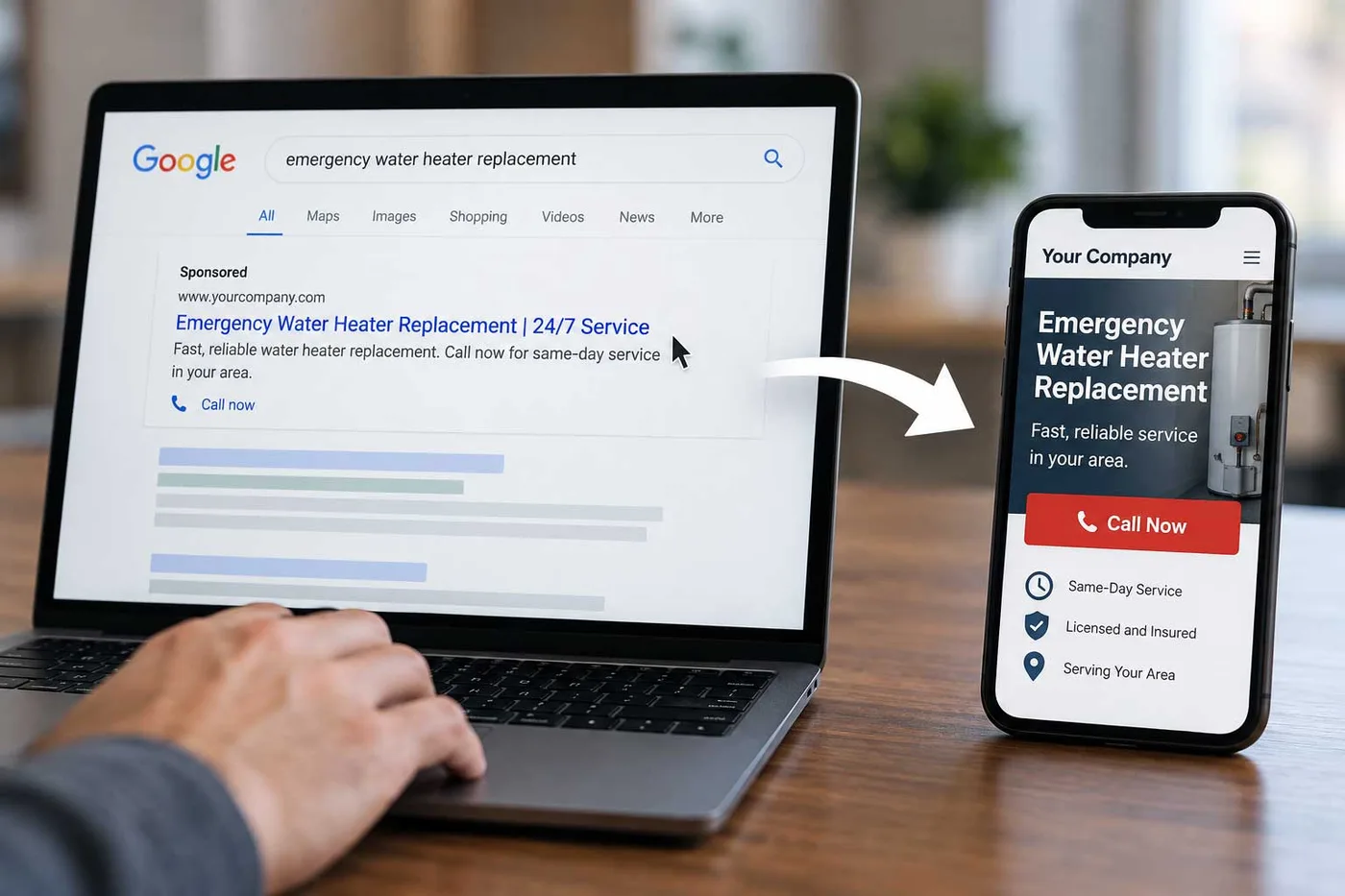
When I review a Google Ads account for a client, I start in the dashboard. I read through the ads, then check the final URL on each one to see where the click actually goes.
In the accounts I have reviewed over the years, the ad itself tends to be the most carefully built piece. The headline speaks to the search. The copy is clear. The offer makes sense.
Then the final URL points to the homepage. Or a service area page. Or a general services page written years ago to explain everything the business does.
I have watched that setup struggle enough times that it is the first thing I check now.
What Happens After the Click
Someone searching on Google is looking for one specific thing. They type it in, see an ad that promises it, and click. At that moment they have told you exactly what they want.
Google defines landing page experience as how relevant and useful your landing page is to the people who click your ad. Their own example is about as plain as it gets: if someone searches for flannel shirts and clicks an ad for flannel shirts, the page they land on should feature flannel shirts.
Google's guidance on improving landing pages also says to keep messaging consistent from the ad to the page, and to make sure the page follows through on the ad's offer or call to action.
That is the whole idea. The ad makes a promise. The page keeps it.
What Evergreen Pages Are Built For
A service area page does a real job. It helps a business show up for searches across the towns it serves, and it gives someone browsing the site a clear picture of where the business works.
Those strengths come from covering a lot of ground. A person who clicked an ad is looking for one answer, and a page built to cover a lot of ground makes them hunt for it.
The homepage has the same issue on a bigger scale. It introduces the whole business to everyone who arrives. The person who clicked your ad for emergency water heater replacement arrives in the middle of a problem and wants to know two things: can you handle this, and how fast can I reach you.
Every extra step between the click and that answer is a chance for them to go back to the search results. The next ad is one tap away.
What Google Is Measuring
The page also affects the ad itself. Google factors landing page experience into its assessment of ad quality, and according to Google, ad quality affects whether your ad can show, where it appears, and how much you pay per click. Higher quality ads typically cost less per click.
You can see how Google rates your landing page experience right in the account, keyword by keyword, as Above average, Average, or Below average. Google describes the 1 to 10 Quality Score as a diagnostic tool, separate from the auction itself. A Below average landing page rating is still Google pointing directly at the page.
A Dedicated Page Can Still Miss
Building a landing page is the right move. It is also only the start. When I have seen a dedicated landing page underperform, friction has been the common thread.
A form asking for ten fields when the first conversation only needs three. Someone ready to reach out stops to decide whether they want to hand over their address, their budget, and the best time to call before they have spoken to anyone.
A call to action sitting below the fold. On a phone, the first screen is the whole first impression. When the button or phone number sits three scrolls down, the visitor has to go looking for it.
Messaging that talks past the visitor. The page covers the company's history and philosophy while the visitor wants to know whether you service their town and how quickly you can come out.
Each one adds a step between the visitor and the phone call.
What Alignment Looks Like
When the ad and the landing page are built together, the page picks up right where the ad left off. Google notes the page can use its own wording for the search phrase. What has to carry over is the promise, so the headline picks up whatever the ad offered and the visitor knows in a second or two that they landed in the right place.
After that, I look at it the way I would look at any system: where can this break between the click and the phone call? The page has to load fast, and Google notes load speed can decide whether a visitor leaves or buys. The phone number and call to action belong on the first screen of a phone, where nobody has to scroll to find them. The form asks for a name, a way to reach them, and a line about what they need. That is enough to start a conversation.
Everything else on the page is there to answer what the visitor is wondering at that moment: what you do, whether you cover their area, and why they should trust you.
I have seen what happens when those pieces finally line up. In more than one account, the change that moved the results was the page behind the click.
The Step That Gets Skipped
I have reviewed a lot of Google Ads accounts, including ones set up by other agencies and by business owners themselves. Across those accounts, the landing page is the step I find skipped more than any other.
It is an understandable shortcut. The campaign is built, the ads are approved, the budget is running, and pointing everything at an existing page gets it all live today. A dedicated page takes another round of work.
The cost of that shortcut shows up in every click afterward. The business pays for each visitor the ad brings in, and each of those visitors arrives on a page built for someone else.
A dedicated landing page gives every one of those paid clicks a better chance of turning into a call.
A Quick Check You Can Run Today
If you are running Google Ads, go into your account and check the final URL on each of your ads. Then open each of those pages on your phone.
Read the page as if you had just searched for that service. Within the first few seconds, does it answer the question the ad raised?
If you want a second set of eyes on your ads and the pages behind them, call 516-880-4201 or visit boxermediacorp.com.