
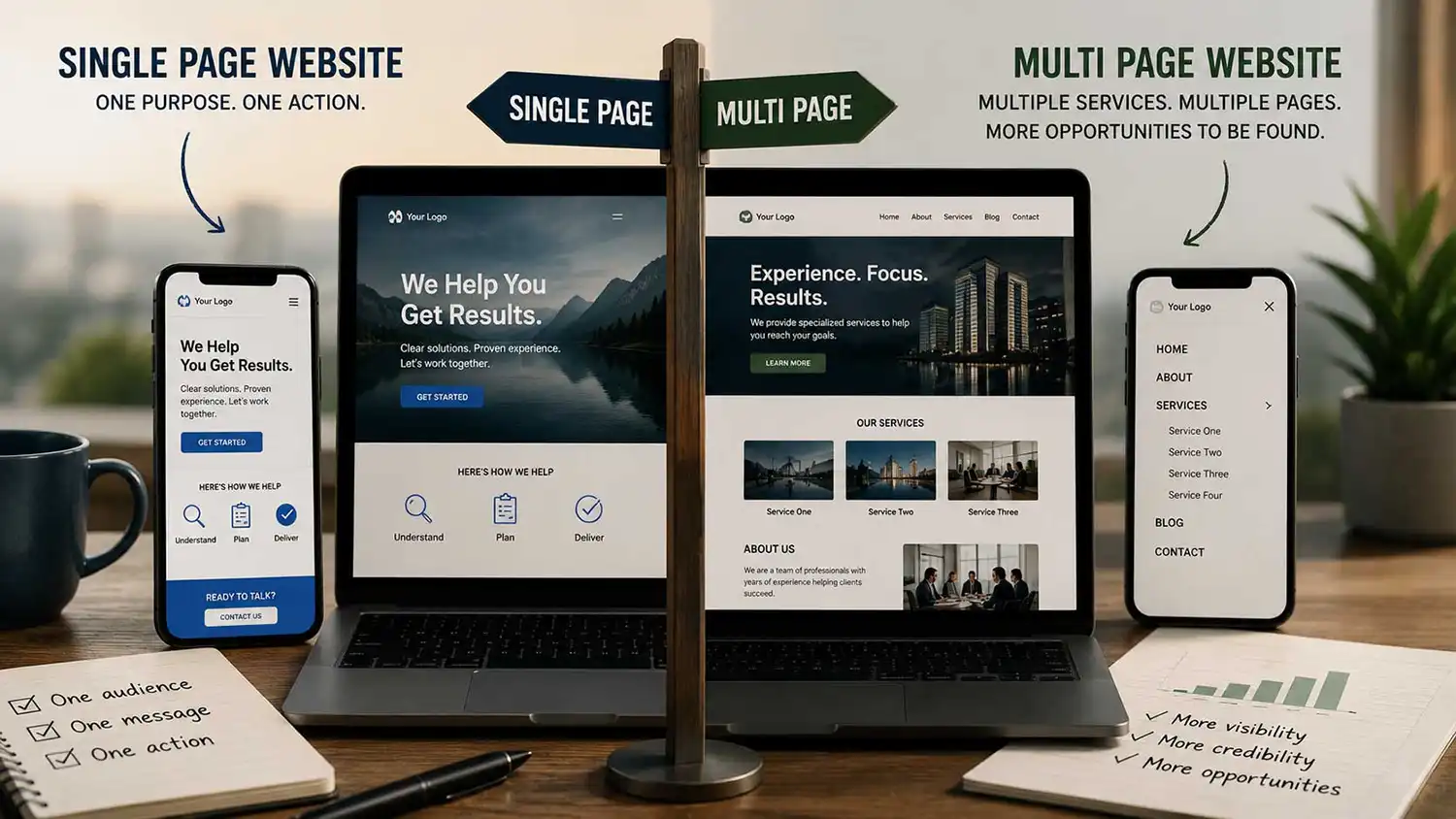
The easiest way to lose credibility as a web designer is to tell every business it needs a ten-page website.
Sometimes that is true. Sometimes it is the wrong recommendation entirely.
I have built well over 100 websites for small businesses, and I have recommended single-page websites to clients when that was the right tool, even though it meant recommending a smaller project. The goal is to build the website the business actually needs, not the largest one I can justify.
The question of how many pages a site needs is not a design question. It is a strategic one. And the answer depends entirely on what the site is supposed to do.
What every successful single page has in common
Every single-page website I have built that actually worked had one thing in common. It was designed to answer one question for one audience and lead them toward one action.
A referral landing page is the clearest case. When I build a page for a networking group or a referral partner, the goal is not to rank in search. It is to give one specific audience a focused place to land that explains exactly what to listen for and how to make an introduction. That page does not need a blog. It does not need five service pages. It needs to be clear, fast, and easy to act on.
Event and campaign pages work on the same principle. One event, one date, one registration link. A multi-page site would be clutter.
Early-stage businesses sometimes need to establish a presence before the full site is ready. A well-built single page that explains what the business does, who it serves, and how to get in touch is far better than a placeholder or nothing at all.
Secondary projects or side services are often well served by a single page, particularly when the goal is presence rather than search visibility. A business that has a main site and wants a focused page for a specific audience does not need to build a second full site.
I have seen single pages outperform bloated five-page sites that did nothing well. A focused single page with a clear purpose will almost always outperform a sprawling site with no direction.
When the job changes, the recommendation changes
Everything above works because search visibility is either not the goal or not the primary way those businesses get found. The moment that changes, so does the recommendation.
A single page can only rank for a very limited set of searches. Every service that does not have its own dedicated page becomes much harder to rank for independently. A law firm with one page covering real estate, employment, business litigation, and landlord-tenant law is asking Google to understand four distinct practice areas from a single URL. Google ends up making educated guesses instead of reading a dedicated page for each service.
The same logic applies to service areas. A contractor who serves ten towns but only has one page is going to have a much harder time earning visibility across all ten markets. Location-specific pages exist for a reason.
For professional services, the issue goes beyond search. An attorney, an accountant, or a financial advisor is asking a potential client to trust them with something consequential. A single page does not give that prospect enough to evaluate. They want to understand the firm's specific experience, read about the people they would be working with, see evidence of knowledge through published content, and find a reason to pick up the phone. A single page cannot carry that weight.
Google takes this seriously too. For YMYL categories, those covering legal, financial, medical, and other high-stakes topics, the bar for credibility is higher because the consequences of a bad recommendation are real. A single page with limited content is competing against firms with years of published articles and detailed service pages. That gap is hard to close.
The real question
The question is not how many pages a site has. It is whether the structure matches the purpose.
If the goal is to serve one audience with one message and one call to action, a single page built well is exactly enough. If the goal is to be found by people who do not already know you exist, to rank for multiple services in multiple locations, and to build credibility with someone making a significant decision, a single page is the wrong tool regardless of how well it is built.
Most businesses that come to me need the second. A few need the first. The conversation I have at the start of every project is about figuring out which situation they are in, not which one they assumed they were in.
One question worth asking before you build anything
Start here: do you need strangers to find you through search?
If the answer is no, because the page serves a specific referred audience or a single campaign, a well-built single page is probably the right call. Build it well, make it fast, make the one action obvious, and leave it at that.
If the answer is yes, your business has probably outgrown a single page.
Neither answer is wrong. The mistake is not asking the question before you build.
Call 516-880-4201 or get in touch if you want to talk through which situation your business is in.