
Therapy and counseling
Websites for therapists, counselors, and group practices.
Someone looking for a therapist wants to know whether you work with what they are dealing with, whether you are taking new clients, what it costs, and whether you seem like someone they could talk to. A site that answers all four plainly does more than one that opens with a stock photograph of stacked stones.
At a glance
- Built for
- LCSWs, LMHCs, LMFTs, psychologists, and group practices
- Platforms
- Bespoke, Wix, or Squarespace
- Works alongside
- Your directory listings, client portal, and telehealth platform
- Starting at
- $2,500 for a site, $500 for a landing page
~80
Sites currently managed
Over 90%
Client retention
30+
Years in marketing and IT
How people choose
People choose a therapist on fit, and they usually decide alone.
Most people looking for therapy do the research privately, often after putting it off for months. They read more carefully than almost any other kind of visitor, and they are looking for one thing above the rest: a sign that you understand what they are dealing with.
A directory listing gets you into the comparison. The website is usually where the decision gets made, because it is the only place with room to explain how you work, who you work best with, and what a first session is like. A listing and a thin site leave someone with a headshot and a list of specialties shared by everyone else on the page.
The site's job is to make the first call easier to make. That means plain answers about fees, insurance, availability, and where you are licensed, written in a voice that sounds like you do in the room.
What gets built
The pieces a therapy practice site needs.
Six things that shape the build for a practice in this field.
A page for each area of focus
Anxiety, trauma, couples, grief, each on its own page. People search for what they are living with, and a page that speaks to one concern reads as understanding rather than a list of keywords.
Approaches in plain language
EMDR, IFS, CBT, and the rest, explained for someone who has never heard of them, and findable by the people who have and are searching for a practitioner by name.
Fees and insurance, stated
Session rates, whether you are in network, superbills for out-of-network reimbursement, and a sliding scale if you offer one. Leaving it off does not avoid the question. It moves it to a call some people never make.
Where you can see people
In person, telehealth, or both, and the states you are licensed in. A therapist licensed in two states should say which before someone in a third one books a consultation.
A first contact that asks for little
A name, a way to reach them, and a good time to call. The form should not invite anyone to describe what they are going through. That belongs in your intake, not an email inbox.
Directories and search in agreement
Google Business Profile, your directory listings, and the site describing the practice the same way, with schema markup stating what you treat and where. Consistency is what lets search engines and AI tools describe you correctly.
Privacy is part of the design. The website does not collect clinical information. Intake, scheduling, messaging, and payment go through the HIPAA-compliant platform you already use, and analytics and ad tracking are set up conservatively, because which page someone read on a therapist's site can say more about them than it would anywhere else.
In this field
Built for a practice licensed in two states.
A site for a trauma therapy practice seeing clients in person and by telehealth in New York, and by telehealth in Florida.
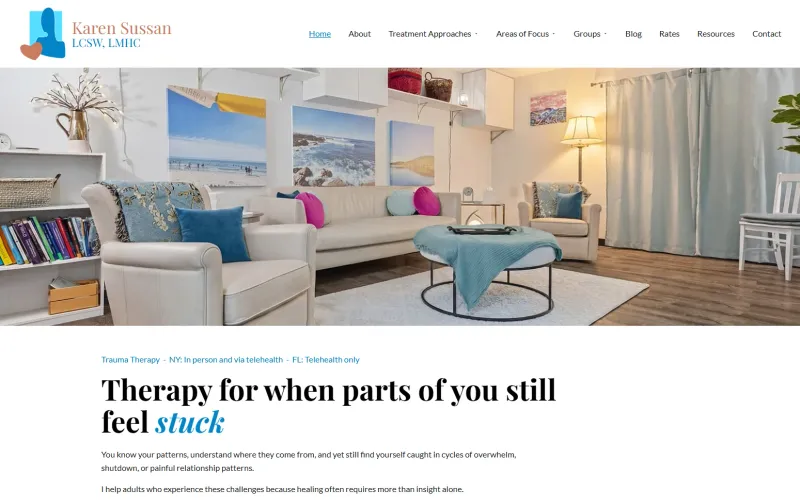
For what sustained website, blog, and social media work produces over years rather than months, see how this works over time. The rest of the portfolio is on the work page.
Who this suits
Practices that want to be found by the right clients.
A good fit
- Solo therapists and small group practices
- You want more clients in the areas you most want to work in
- Most of your inquiries come through a directory, and you want something of your own
- Your current site was built once and left alone
- You can talk through how you work, in your own words
Worth knowing
- Search visibility takes months; keep your directory listings meanwhile
- The site links to your client portal rather than replacing it
- Rates and insurance pages need a check whenever either changes
If your site is fine and the real gap is that nobody finds it, that is SEO and content rather than a rebuild.
Platforms, process, and what is included: see the web design service page →
Landing pages start at $500. Websites start at $2,500. See full pricing →
Questions
What therapists ask first.
Does my website need to be HIPAA compliant?
The safest arrangement is a website that never asks for health information in the first place. Even a name and an email sent to a therapist can be sensitive, so the contact form asks for as little as possible and tells people not to include clinical details. Intake, scheduling, messaging, and payment go through a HIPAA-compliant platform that will sign a business associate agreement, and the site links to it. I am not a compliance adviser, and if your situation is unusual, your own counsel or your platform's provider is the right place to confirm it.
Should I keep my Psychology Today listing if I have a website?
Usually, yes. Directories are where many people start comparing, and a listing keeps bringing inquiries while a new site is still building search visibility. The two should work together: the listing links to the site, and both describe the practice the same way. The difference is ownership. The website is yours; a directory profile is a small box on a page full of your competitors.
Should I list my fees on my website?
Practices that do tend to get better inquiries, not fewer. Someone who already knows the session rate, whether you take their insurance, and whether you provide superbills for out-of-network reimbursement has decided the cost works before they call. If you see self-pay clients, the notice of their right to a Good Faith Estimate belongs on the site as well.
Can I advertise my practice with Google Ads?
Yes, within limits worth knowing before you start. Google restricts ad targeting based on health, so ads cannot follow someone around the internet because they read a page about anxiety, and addiction treatment services need third-party certification before they can advertise at all. For most private practices, ads aimed at specific searches in a specific area, sent to a page about that concern, are both allowed and effective. More on how that works on the Google Ads page.
Do you write the content, or do I?
Either, but your voice has to be in it. People choose a therapist partly on how you sound, and generic lines about a safe, supportive space read the same on every site in the directory. The usual arrangement is a conversation or two about how you work and who you work best with, from which I draft and you revise.
Another psychotherapist recommended I hire Matt to design my website. His advice was and continues to be very sound and customer-friendly. He has been easy to work with and collaborates with his clients very effectively to produce a polished, personally stylized website. He understands how to achieve significant internet impact and guide professionals to reach their goals of visibility and accessibility in their fields.
Next step
Let's talk about your practice.
Send me your current site or your directory profile and I will tell you what it says to someone deciding whether to call, and what it would take to make that decision easier.