
When I tell people what platform I build on, I occasionally get a reaction.
Usually from developers.
Business owners almost never ask what platform a site is built on. They want to know whether it loads quickly, shows up in search, and helps them get more customers. Those are the right questions. Platform preference is a developer conversation, not a client one.
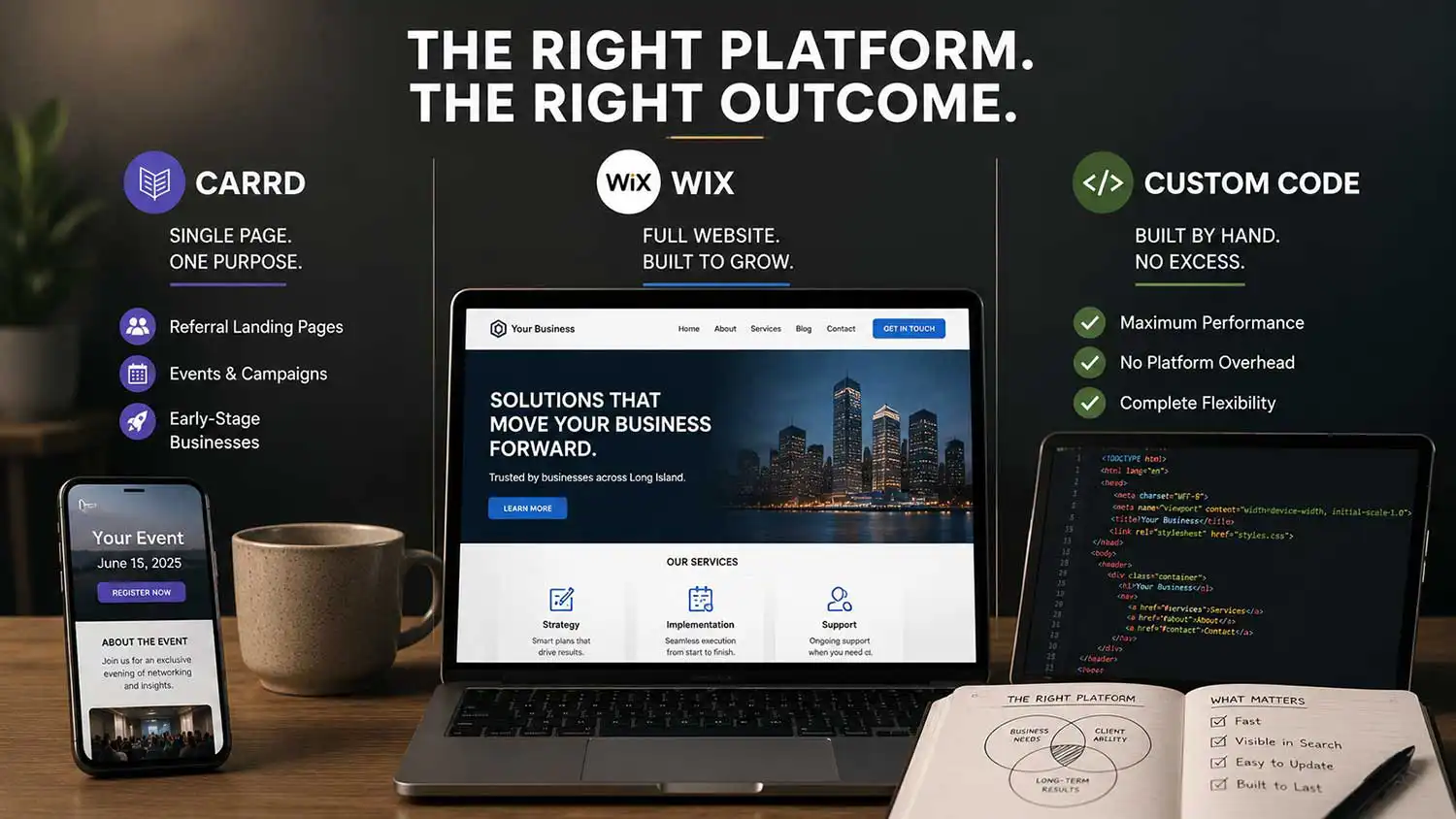
I have never chosen a platform because it impressed another web designer. I choose the one that gives the client the best long-term outcome. Depending on the project, that has meant Wix, Carrd, or hand-written code.
How the decision actually gets made
Before I recommend anything, I need to know a few things about the business.
How many services does it offer, and how many areas does it serve? A business that needs to rank for six services across a dozen towns needs a different structure than one selling a single offering.
Does search visibility matter, or is the site serving an audience that already knows the business exists? A referral landing page and a site competing for local search results have almost nothing in common.
Who will maintain it after launch? A site the owner can update themselves stays current. A site that requires a developer for every change usually does not.
Those answers point to a platform. Not the other way around.
Most of the time: Wix
I have built well over 100 websites for attorneys, contractors, accountants, healthcare practices, and dozens of other local businesses on Long Island. The majority are on Wix, and more than 90 percent of those clients are still working with me.
Wix earns that position by handling what these businesses actually need. Pages load fast on mobile. The SEO tools are built in and do not require plugins to function correctly. The editor is straightforward enough that a client who wants to manage their own content can do it. And when I am building, I can work efficiently without fighting the platform.
Hosting, security, and software updates are handled by Wix. A client is not responsible for maintaining a server, running security patches, or worrying about their site going down because a plugin update broke something. For a small business owner, that is a real and recurring cost that often goes unaccounted for when comparing platforms.
The old criticism of Wix for SEO was once legitimate. Early versions generated slow-loading pages with messy underlying code, and developers who evaluated it in that era had real reasons to avoid it. That version of the platform no longer exists. In the 2025 Web Almanac, Wix was the only content management system analyzed to hold a median Lighthouse SEO score of 100 on both desktop and mobile for two consecutive years. By November 2025, just under 75 percent of Wix origins were passing Core Web Vitals, up from 3 percent five years earlier. The platform now handles XML sitemaps automatically, supports schema markup, integrates with Google Search Console, and manages 301 redirects without requiring a developer.
Boxer Media is a Wix Legend Partner, the top tier of the partner program, reflecting the volume and consistency of the sites I have built on it.
When it is one page: Carrd
Carrd exists to do one job well: single-page sites with one purpose.
I use it when a client tells me they need a landing page, or when I determine after an initial conversation that a full website is not what the situation calls for. A referral landing page, an event page, or an early-stage business that needs a presence before building something more substantial: Carrd handles those cleanly and without unnecessary complexity.
It is not a platform for a business that needs to rank for multiple services across multiple locations. For that, the structure of a full site matters. But for one page with one purpose, Carrd is the right tool. Using it in that situation is not cutting corners. Putting a client on a full CMS when they need a landing page would be.
When it needs to be lean: hand-written code
For some projects, the right answer is code. I write HTML, CSS, and JavaScript from scratch, host it on GitHub, and deploy through Cloudflare Pages. Contact forms route through SMTP2GO to deliver submissions directly to the client's email.
The result is a site with no platform overhead, no plugins, nothing running that does not need to be there. It loads fast because there is very little behind the scenes.
The tradeoff is that the client cannot manage their own content without coming back to me. For most small businesses, that alone rules it out. But for a client who is not going to be updating the site anyway and wants the fastest, cleanest version of what they need, it is the right call.
Platforms are tools
The developers who argue about platforms are usually evaluating them against requirements that do not apply to a local business owner. For a team building custom enterprise software, their criticism of a given platform may be valid. For a plumber in Smithtown who needs to rank in local search and have a site that converts visitors into calls, it is not the relevant comparison.
The right platform is the one that fits what the business needs, what the client can maintain, and what will still be performing two years after launch. Sometimes that is the most technically sophisticated option. More often it is not.
The logo on the platform has never been the point. The outcome is.
If you want to talk through which approach makes sense for your business, call 516-880-4201 or get in touch.