
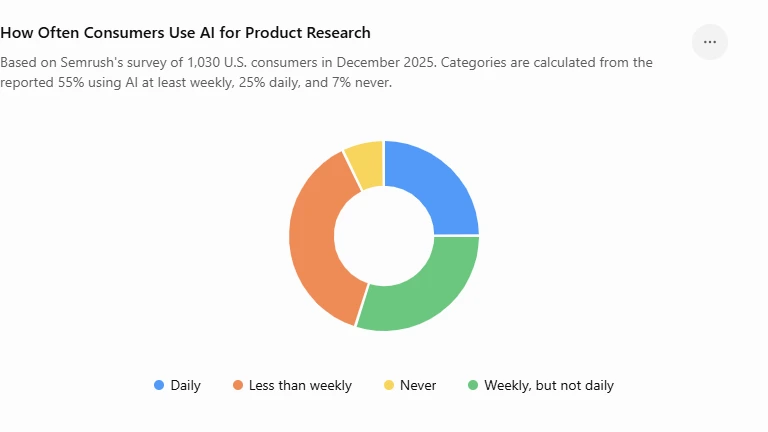
A chart came across my feed last week showing how often people use AI to research products. Big numbers. 55 percent doing it at least weekly, 25 percent daily, only 7 percent who never do it at all.
My first reaction was that I should probably be doing something about this.
So I went and read the actual study, and then I went and read what Google has published on the subject, and I came out the other side thinking something fairly different.
The Numbers Are Real
The chart is from Semrush. They surveyed 1,030 US consumers in December 2025 and the numbers hold up. People really are using AI to research things, constantly, and that is not going to reverse.
What comes next in most versions of that chart is the advice. Audit your Generative Engine Optimization. GEO. A new discipline, separate from SEO, that your business urgently needs.
Semrush also sells an AI visibility product. That does not make their survey wrong. It does explain why the chart ends where it ends.
What Google Published in May
On May 15, Google put out its first official guidance on optimizing for generative AI search. They addressed AEO and GEO by name and said that from Google Search's perspective, optimizing for generative AI search is optimizing for the search experience, and therefore still SEO.
Not a new discipline. The same work.
The guide also has a mythbusting section calling out five things businesses have been told they need for AI visibility: llms.txt files, content chopped into little answer blocks, AI-specific rewrites of pages you already have, manufactured brand mentions, and excessive schema work. None of them is a shortcut into AI Overviews or AI Mode.
Three weeks later, on June 5, Google published separate guidance on third-party SEO tools and updated its hiring guide to add a section on evaluating an SEO's recommendations. It named AEO and GEO as a service category for the first time and made two things explicit. Google does not evaluate or endorse third-party SEO services. And third-party tools do not have access to Google's internal ranking data.
Which means any product reporting your AI visibility score is modeling an estimate. It is not measuring something Google handed over.
The Part That Surprised Me
AI referral traffic is tiny. Clickstream data from Datos put AI tools below 2 percent of desktop visits in the first quarter of 2026, while Google held roughly 94 percent of search. Semrush's own look at manufacturing sites found AI accounted for under half a percent of sessions.
So people are researching in AI all day long and almost nobody is clicking through from it. My first read on that was that the whole thing is overblown.
Then I found the Similarweb study, and it reframed the problem.
They tracked US desktop users who asked ChatGPT a question, got a specific brand recommended, and then watched what those people did over the next seven days. Recommended brands were 2.5 times more likely to get a visit. And 55.9 percent of those visits arrived through search rather than through a click inside the conversation.
Someone asks ChatGPT about something. A brand gets named. They do not click. A few days later they search that brand by name and land on the site as ordinary organic traffic.
The AI did the work and left no fingerprint in anybody's analytics.
Two caveats I want to be straight about, because they are real. The study covers finance, travel, and beauty on US desktop, and Similarweb is careful to say it shows correlation rather than proven causation.
What I Think This Means for a Local Business
Here is where I have to be honest about the limits of all of it.
Every number above is about product research and big consumer brands. Credit cards. Flight search. Cosmetics. Asking an AI assistant to compare moisturizers is not the same behavior as asking which employment attorney to call in Nassau County, and anybody telling you those numbers transfer cleanly to professional services is extrapolating well past the data.
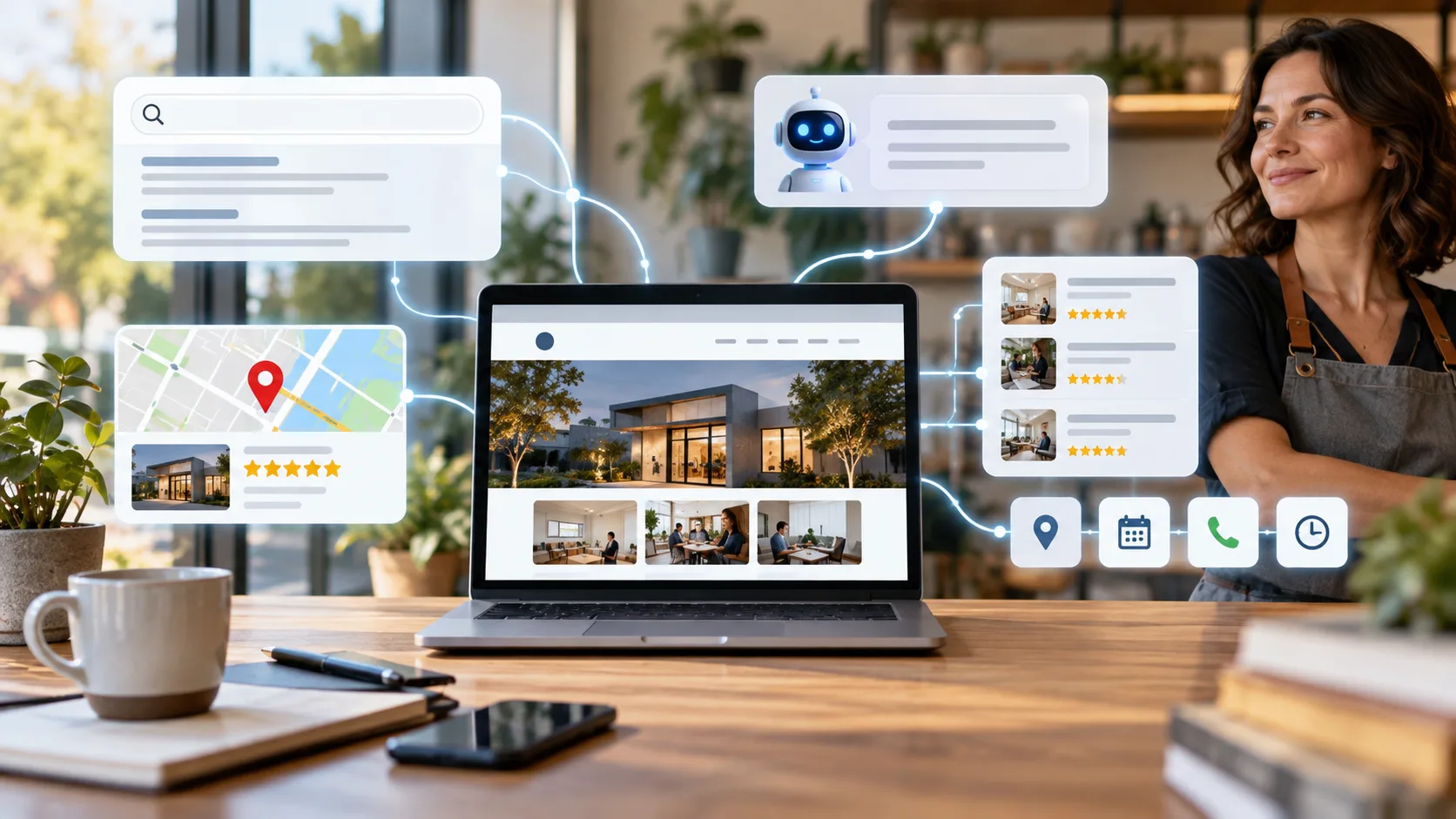
What does carry over is the mechanism. When an AI assistant answers a question about a local service, it is pulling from the same places it has always pulled from. Your website. Your Google Business Profile. Your reviews. Whatever credible third-party sources mention you by name.
Thin or inconsistent gives AI very little to work with. Solid gives you a chance.
That is not a new problem with a new solution. It is the same problem with the same solution.
What Actually Works
Google basically comes back to the same three things. Useful content based on what you actually know. A website that works properly. Accurate information about the business everywhere Google expects to find it.
That is not GEO. That is SEO.
I have written some version of those three things in almost every post on this site, which is sort of the point. The work that makes you findable in ordinary search is the work that makes you citable in an AI answer, because both systems are solving the same problem. Figure out which businesses are real, relevant, and worth putting in front of somebody.
How to Evaluate Anyone Selling You GEO
Google's June guidance gives business owners a pretty simple test.
Ask whether the recommendations line up with Google's published guidance. If somebody is selling llms.txt files, content chunking, or AI-specific schema as the path to AI visibility, they are selling things Google has explicitly said you do not need.
Ask what data any AI visibility score is built on. If the answer is proprietary modeling presented as measurement, treat the number as an estimate, because that is what it is.
Walk away from anyone claiming to be Google-approved. Google does not endorse third-party services and says so in writing.
Be skeptical of confident expertise in a field that did not exist two years ago. One analyst put it well recently, saying that anybody claiming to have GEO figured out is either overconfident or selling something, possibly both.
Where I Landed
People are using AI to research things in large numbers and that will keep growing. The influence is real even though the referral traffic is not, which makes it genuinely hard to measure and easy to sell panic about.
The place people get the answer is changing. The work that gets a business into that answer really hasn't.
Useful content. A technically sound website. Accurate business information. A reputation that holds up when somebody checks. That was the answer before any of this and it is still the answer now.
If somebody is selling you something dramatically different, they are selling the panic.
If you want to talk through where your business actually stands, call 516-880-4201 or visit boxermediacorp.com.